
The shape of a century
Between 1972 and 2024, the U.S. total recordable incident rate fell from 10.9 per 100 workers to 2.3. That is a 79 percent decline, and the lowest figure in the BLS series going back to 2003. The number of workers killed on the job every day dropped from about 38 in 1970 to about 14 in 2024. Those are not marketing numbers. They are real people who went home when they would not have gone home before. (The decline is in the rate. The plateau, as we will see, is also in the rate, and the absolute numbers have moved the wrong way: 4,690 workers died on the job in 2010, and 5,070 died in 2024.) The first century of modern safety worked.
The second thing to say is harder. For the last fifteen years, the curve that matters most has gone flat. Fatality rates have stayed between 3.3 and 3.7 per 100,000 workers since roughly 2010, with the 2024 reading coming in at 3.3, at the lower edge of the plateau but still inside it. Serious injuries and fatalities, what the field now calls SIFs, have plateaued even as total recordable rates keep drifting slowly down.
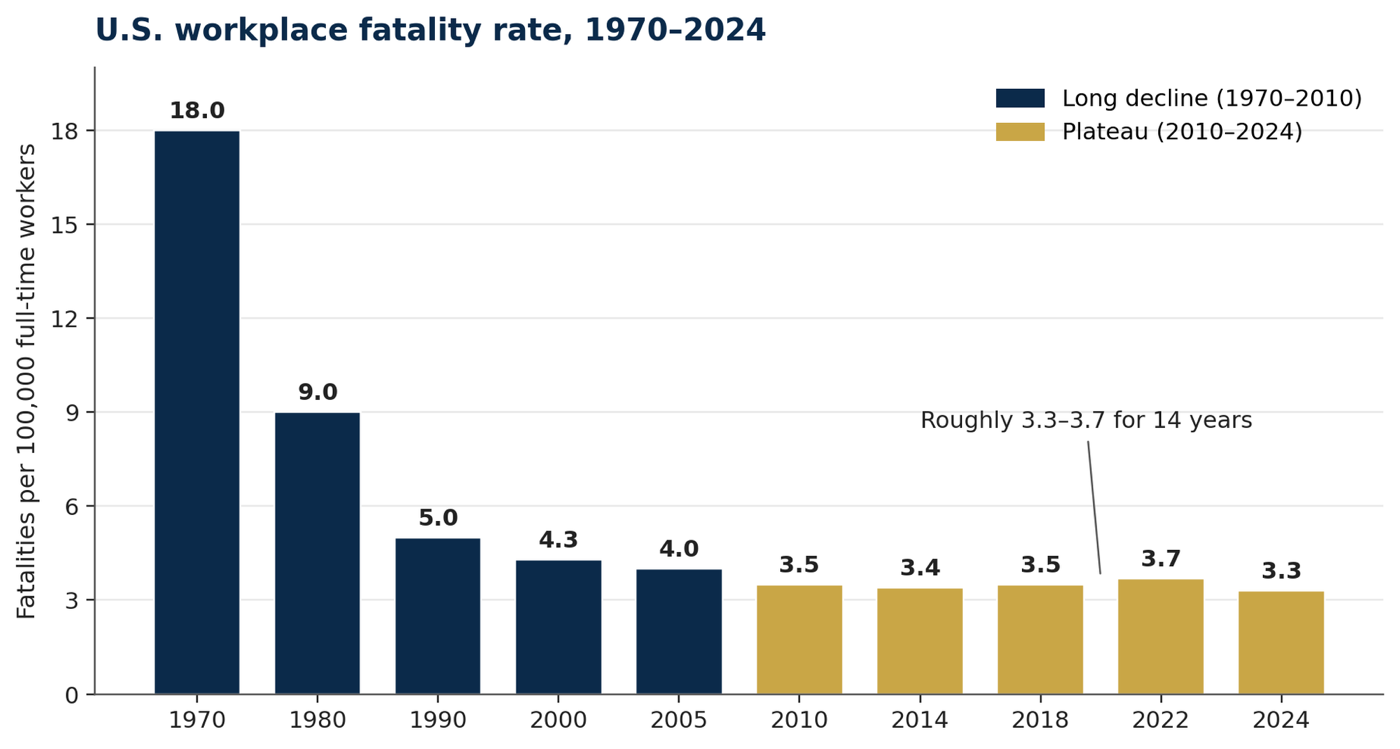
That plateau is the central puzzle of contemporary safety. It is the reason the profession is restless. And it is the reason we wrote this paper.
“I think there are three eras in this. Safety as a slogan. Systems and behaviors. Prevention and prediction.”
Three eras got us here. Each one was an honest answer to a question the era before could not solve. Each one is still present in the organization you run today. And the reason the plateau is not moving is not that any of them was wrong. It is that none of them, on their own, was ever meant to carry the whole weight.
What follows is our read on how we got here, what actually moved the needle, what did not, and what we think finally breaks the plateau. A preview of where this lands: the next frontier is not a fourth program. It is the integration, in the integral and holistic sense, of everything we have already built. Objective and subjective. Technical and human. Finally connected.
Era 1. Safety as a slogan
(Pre–1970s)
The first era of modern safety started long before OSHA existed. It ran from the industrial revolution through the Triangle Shirtwaist fire in 1911, through the first workers’ compensation laws, and up to the Occupational Safety and Health Act of 1970.
For most of it, workplace safety was less a management discipline than a moral exhortation. Posters. Signs. Supervisors telling crews to be careful. Counting fingers at the end of the shift.
The slogan that named the era came out of an unlikely place: the steel mills. United States Steel institutionalized “Safety First” starting around 1906 to 1908, when Elbert Gary convened the company’s Committee on Safety. It was not just a poster campaign. The company embedded the phrase in training, in supervision, and in the way it talked to its workers. The implicit argument, radical for its time, was that production should never come at the expense of human life. For U.S. Steel, Safety First was an operating principle. For the rest of the industry that adopted it, it was mostly a slogan — the belief that if people would just put safety first, everything else would fall into line.
What followed mattered more than the slogan. Within a few years the Safety First Movement had moved well beyond U.S. Steel and pushed responsibility for workplace harm away from the individual worker, where Industrial Revolution thinking had quietly placed it, and toward the leadership and the organizational systems that actually shaped the conditions of the work. That move, from the worker as the unit of analysis to the organization as the unit of analysis, is the move we are still finishing more than a century later.
The defining voice of the era was Herbert William Heinrich, an Assistant Superintendent at Travelers Insurance. In 1931 he published “Industrial Accident Prevention.” The book gave us two ideas that shaped safety for the next forty years. The 300–29–1 pyramid. And the claim that 88 percent of accidents were caused by the unsafe acts of workers.
The numbers were wrong.
Heinrich’s original case files were eventually lost. Decades of independent analysis since have shown that the ratios vary widely by industry and that minor incidents are not reliable predictors of fatalities, a finding the SIF research community would later make central. Worse, his data came from supervisors assigning cause in insurance files, a dataset structurally designed to over-report worker error and under-report management decisions, design defects, and the latent conditions the organization had quietly planted.
“Heinrich’s framing asked a plant to count the number of times somebody slipped. It did not ask why the floor was wet.”
And yet the frame held. For forty years it made safety look like a behavior problem. It made the worker the unit of analysis. It made enforcement the intervention. It gave us the safety slogan, the safety award, and the “safety is everyone’s responsibility” poster that still hangs in plants around the world.
What actually moved the numbers in this era was not the slogan. It was the law. OSHA in 1970. Mandatory reporting. A federal data layer. The fatality rate in the U.S. fell from roughly 14 to 18 per 100,000 workers in 1970 to about 5 per 100,000 by the early 1990s, with the Census of Fatal Occupational Injuries giving us a reliable national series from 1992 onward. Most of that progress came from a structural change, not a cultural one.
What this era gave us that still matters:
A shared vocabulary. A first generation of dedicated safety professionals. The moral conviction that work should not kill people. And even in its flawed form, the intuition that small signals matter.
What this era left behind that still gets in the way:
The reflex to count unsafe acts. The reflex to blame the worker. The reflex to believe that a low Total Recordable Incident Rate (TRIR) is the truth about a workplace. Those reflexes are very much alive in 2026, and they are part of why the second era eventually hit its own wall.
Era 2. Systems and behaviors
(1970s–2010s)
Once the law made safety a management responsibility, the discipline grew up fast. Three parallel streams of thinking defined the second era, and each one was a response to a different kind of failure.
The systems stream
Flixborough, 1974. Bhopal, 1984. Piper Alpha, 1988. Texas City, 2005. Deepwater Horizon, 2010.
These were not stories about inattentive workers. They were stories about pressure vessels, valves, procurement choices, management decisions, and the slow drift of a complex organization toward the edge of what its systems could hold.
OSHA published the Process Safety Management (PSM) standard, 29 CFR 1910.119, in 1992, directly in response to Bhopal and to the Phillips 66 explosion in Pasadena in 1989. Fourteen elements. Process Hazard Analysis. Management of Change. Mechanical Integrity. Pre-Startup Safety Review. It is still one of the most important pieces of workplace safety regulation ever written.
Alongside PSM came Layer of Protection Analysis, HAZOP, Fault Tree Analysis, and an international management system approach that eventually crystallized in ISO 45001 in 2018. By 2024, more than 540,000 organizations in over 80 countries had adopted it.
A related thread is Safety Management Systems (SMS) and the confidential close-call reporting that runs through some of them. The results have been uneven by industry — strong at NASA and parts of commercial aviation and nuclear, weaker in rail and some construction sectors. SMS produces real learning when leaders use it for learning. It produces compliance theater when leaders use it to insulate themselves from what is actually happening at the work face.
The conceptual centerpiece of the systems stream is James Reason’s Swiss Cheese Model, introduced in the late 1980s and fully developed in his 1997 book, “Managing the Risks of Organizational Accidents.” Reason’s argument is that most accidents in complex systems are not caused by a single unsafe act. They are caused by the alignment, at a specific moment, of holes across multiple layers of defense. Some are active failures by the people at the sharp end. Many more are latent conditions planted months or years earlier by decisions about design, staffing, training, and incentives.
Reason’s insight reframed the central question. What did the worker do is no longer the right starting place. What did the organization do to them, over time, is.
Around the same time, Nancy Leveson at MIT and a number of former DuPont safety leaders were pushing the systems stream further still. Their argument, often summarized as “complex systems fail in complex ways,” was that in tightly coupled, high-hazard operations the accident is not the breakdown of any one part. It is what emerges when multiple well-designed parts interact in ways the designers never imagined. Leveson formalized this in her STAMP and STPA work, a systems-theoretic approach to hazard analysis that treats safety as an emergent property of the whole system rather than a property of any individual layer. The DuPont leaders applied the same instinct on the operating side, pushing toward inherently safer design, redundancy, and the disciplined verification of critical controls.
What Leveson and the systems thinkers added to Reason was a harder truth. As systems get more complex, failures get less predictable, more interactive, and more systemic. You cannot prevent them by hardening any one layer. You have to design the whole thing to fail safely.
The behavior stream
In parallel, another stream was quietly rewriting the part Heinrich got wrong. Behavior-based safety, starting with E. Scott Geller’s work in the 1980s, built on applied behavior analysis. Larry Wilson founded SafeStart in 1998 and produced one of the most widely deployed frameworks in the field.
SafeStart’s insight is elegant. More than 95 percent of accidental injuries can be traced to four human states (rushing, frustration, fatigue, complacency) combined with four critical errors: eyes not on task, mind not on task, line of fire, and loss of balance, traction, or grip. Millions of workers across more than sixty countries have been through it.
It is worth pausing on this number. SafeStart’s 95 percent is not Heinrich’s 88 percent in disguise. Heinrich located the cause of accidents in the moral failing of the worker, in the “unsafe act” as the unit of analysis. Wilson’s frame locates the four states as a predictable byproduct of the system the worker is operating in. The system that asks people to rush is the cause. The frustration, the fatigue, the complacency are the symptoms the system produced. The field has not always been careful about the distinction, and the slide from one to the other is part of why behavior-based safety lost some of its credibility in the years that followed.
The behavior stream took root because it worked. Behavior-based safety delivered real reductions in recordable rates in the 1990s and 2000s. What the stream eventually had to learn, however, is the limit of what training can do. A fatigued operator is a system problem before it is a behavior problem. You cannot train your way out of a scheduling decision.
The culture stream
The third stream of Era 2 was about the human side of the system. The dominant artifact of this stream was DuPont’s Bradley Curve, developed internally in 1995 and adapted from Stephen Covey’s work. It set out a four-stage maturity model: Reactive, Dependent, Independent, Interdependent. It was popular for a reason. It gave leaders a vocabulary for talking about culture as a lever rather than as an afterthought, at a moment when most organizations did not have one. The irony is that for a model so widely adopted, the empirical grounding has always been thin.
But the model has not aged well. It oversimplifies the way safety performance actually changes. It implies a linear progression driven by attitudes and “hearts and minds,” which lets organizations invest heavily in engagement campaigns while their high-risk conditions remain unchanged. It offers very little objective ground to verify whether an organization has truly matured. And more than a few well-known companies that placed themselves at the top of the curve have walked themselves into fatalities they should have been able to see.
Newer cultural maturity work shifts the question from mindset to capability. The Energy Institute’s Hearts and Minds toolkit is one of the cleaner examples, with the Hudson Safety Culture Ladder running from Pathological through Reactive, Calculative, Proactive, and Generative. The questions it asks are different from Bradley’s. How well does the organization identify its material risks? How well does it design its layers of protection? How well does it verify, in the field, that the critical controls are in place and working? How well does it manage change, and how well does it learn from weak signals? Those are the questions that distinguish organizations that prevent serious incidents from organizations that talk a good game about culture. The Bradley Curve gave the field a starting vocabulary. The Hearts and Minds work is what comes next.
At the same time, Amy Edmondson’s research at Harvard Business School introduced the idea of psychological safety. Her counter-intuitive finding came out of a 1996 study of hospital nursing teams. The best-led teams did not have the fewest reported errors. They had the most, because the people on those teams were willing to speak. She formalized the psychological-safety construct in a 1999 paper in Administrative Science Quarterly that has since become one of the most cited pieces of organizational research of the last thirty years. What most people call psychological safety is really rooted in trust — the worker's read of whether the leader is available, whether the leader will react, and whether the leader has built enough intimacy with the people doing the work that the truth can travel between them.
“Safety culture, at its core, is a question of voice. It is about whether the person closest to the work can tell the truth about it, and whether anything happens when they do.”
Where Era 2 hit the wall
Between 1972 and 2024, the U.S. TRIR fell from roughly 10.9 per 100 workers to 2.3. That is the 79 percent decline we opened with. It is a genuine achievement of the safety profession.
Then something unexpected happened. TRIR kept drifting slowly down. Fatalities stopped falling. Between 2010 and 2024 the fatality rate in the United States stayed essentially flat at 3.3 to 3.7 per 100,000 workers. In several industries, including construction, it actually moved the wrong way.
The Campbell Institute at the National Safety Council gave the phenomenon a name. The SIF plateau. Serious injuries and fatalities had decoupled from minor recordables. You could lower one without lowering the other.
“We had been tuning the engine for the wrong variable. TRIR kept going down because we were getting very good at preventing the kinds of injuries that were never going to kill anyone. The injuries that kill people were coming from somewhere else.”
That realization changed the question the field was asking. Not “how do we reduce incidents,” but “how do we identify the small set of high-energy situations with the potential to kill or maim, and prevent those.”
That question is what set up the third era.
How the field itself has been thinking about this
Before we walk into the third era, it is worth pausing on how the field itself has been picturing this evolution. A visual has been circulating inside our industry conversations that reads the same century of progress as additive layering, where each era was added on top of the previous rather than replacing it.
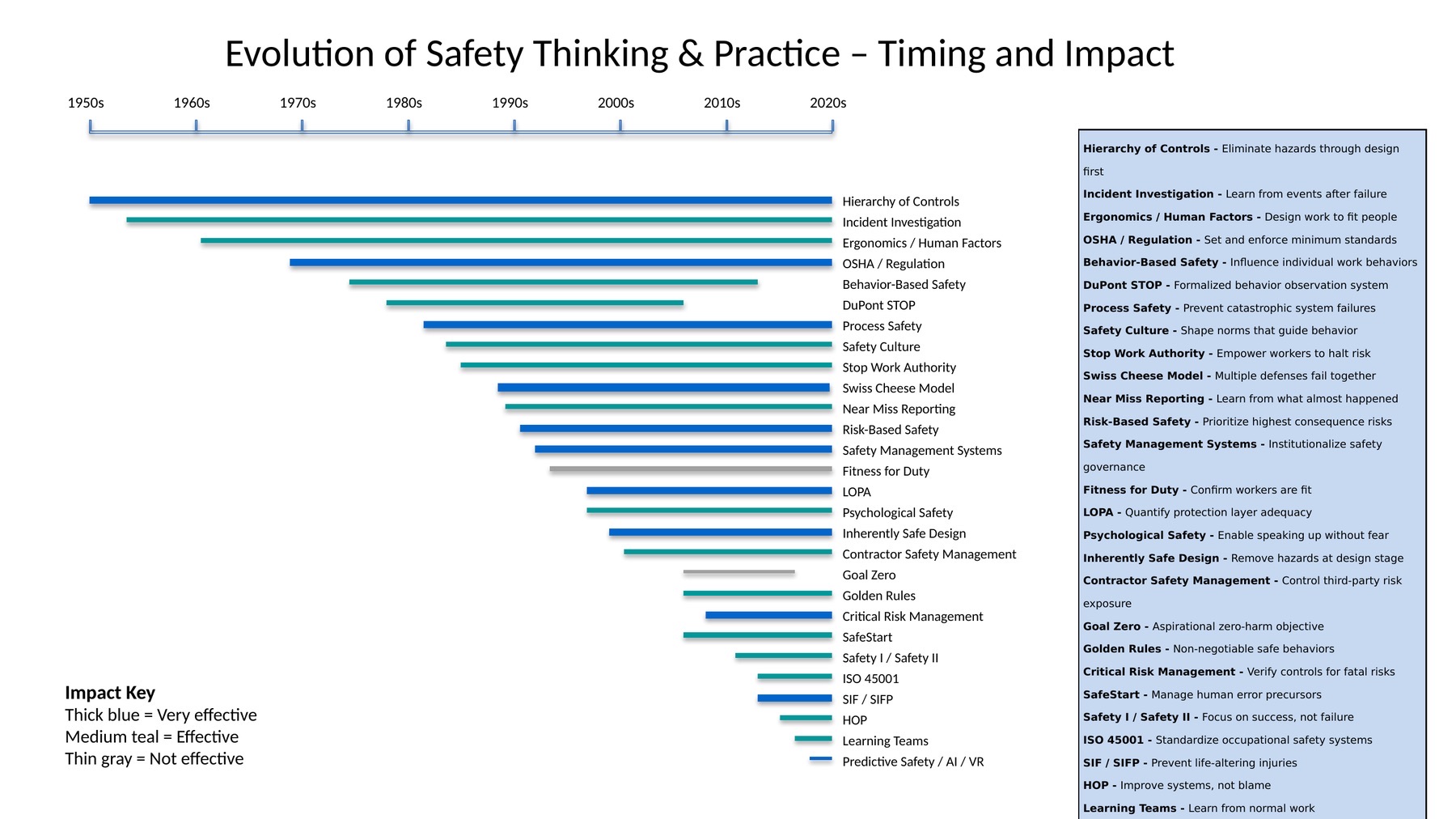
Look at that picture and you will notice something important. Nothing gets replaced. Every layer we have ever added is still there, still running, still doing part of the work. The evolution is additive. Which is exactly why the integration problem is the one we are still not solving.
Era 3. Prevention and prediction
(2010s–today)
The third era is still being written. Four ideas define it. None of them is entirely new. Together, they form a different operating system for safety.
1. Safety is the presence of capacity, not the absence of incidents
Erik Hollnagel, Robert Wears, and Jeffrey Braithwaite crystallized this in their 2015 white paper “From Safety-I to Safety-II,” published by the Resilient Health Care Net. Safety-I, the dominant view for most of the 20th century, defines safety as the absence of failure. It studies what goes wrong, counts it, and tries to prevent it. Safety-II defines safety as the ability to succeed under varying conditions. It studies what usually goes right, and asks how to strengthen that capacity.
The most practical piece of Hollnagel’s thinking is his distinction between Work as Imagined and Work as Done. Work as Imagined is the procedure, the Job Safety Analysis, the management system. Work as Done is what actually happens on the floor, where people adapt, improvise, and get the job done in spite of an imperfect world.
The gap between the two is not a compliance problem. It is the place where both failures and everyday successes come from. A mature safety system pays attention to both sides of that gap.
There is one caveat that Hollnagel’s frame requires. When work goes right, it does not always mean the workers’ adaptations actually kept them safe. Sometimes they were lucky and did not come into contact with the hazardous energy that day. Sometimes the holes in the faulty barriers just did not happen to line up. That distinction, between actual control and good fortune, is part of why the energy-based work in the next section matters.
2. Human and Organizational Performance (HOP)
Todd Conklin spent 25 years at Los Alamos National Laboratory as a senior advisor for organizational and safety culture. He distilled the New View of safety into five principles that are now being adopted across nuclear, aviation, petrochemical, utility, and construction.
- Error is normal. Even the best people make mistakes.
- Blame fixes nothing. It stops learning and drives problems underground.
- Learning and improving is vital. Organizations have to actively seek out what their failures and near misses are trying to tell them.
- Context drives behavior. People act according to the system and environment they are in. Change the context and you change the behavior.
- How leaders respond matters. The response to a failure either builds trust and learning, or destroys both.
HOP is not a program. It is a way of seeing the operation. It reframes the worker as the solver of daily variability rather than the source of it. That is a profound inversion of Heinrich’s 88 percent. It is also the theoretical spine of most of what is happening in good safety organizations today.
3. SIF prevention
The SIF concept was first formalized by Mansdorf and BST in Professional Safety in 2011 and developed by the Campbell Institute at the National Safety Council in a series of white papers across the rest of the 2010s. The argument is straightforward. The conditions that produce serious injuries and fatalities are not evenly distributed across all hazards. They concentrate in a small subset of high-energy exposures, often in the presence of a specific set of precursors. Identify and eliminate those precursors, and you move the fatality curve in a way that counting recordables never will.
In practice, SIF prevention has pushed organizations to build Critical Risk programs, to map the small set of high-energy activities where life-changing outcomes are possible, and to focus their controls and attention there, instead of spreading effort uniformly across every paper cut.
The intellectual force behind the modern SIF program is Matthew Hallowell at the University of Colorado. Hallowell’s argument, grounded in years of empirical research, is that serious injuries and fatalities are not caused by the same factors that drive minor injuries, and that traditional metrics like TRIR actively obscure the real sources of fatal risk. His Energy-Based Safety framework reframes hazard recognition around the type and magnitude of the energy involved (gravity, electrical, mechanical, thermal, chemical) and argues that effective prevention depends on direct, reliable controls on the energy itself, controls that hold even when the human in front of them makes a mistake. Safety performance, in his view, is measured not by injury counts but by the consistent presence and verified effectiveness of those life-saving controls in the field. The shift in attention, from worker behavior to the design and verification of high-energy controls, is one of the most important moves in safety thinking of the last fifteen years. It is also the part of the field that has stopped buying the safety pyramid altogether. Hallowell's High Energy Control Assessment (HECA) is the operational expression of this — a method for measuring safety in real time by verifying that critical controls are actually present and effective at the work face, rather than counting incidents after the fact. It is the most significant paradigm shift in safety metrics of the last decade.
4. Prediction through AI, analytics, and connected data
The last piece of the third era is technical, and it is moving fast. Predictive safety analytics applies machine learning to incident and near-miss data, inspection findings, audit results, wearable and environmental sensor streams, and in some cases computer vision and natural language processing applied to the free text that workers and investigators actually write. The goal is to move safety from a lagging scorecard to a leading signal.
The early results are real. A 2012 Carnegie Mellon study, conducted with Predictive Solutions and the Campbell Institute, used 112 million safety observations across more than 15,000 work sites and produced predictive models with accuracy rates of 80 to 97 percent for certain classes of exposure. Case studies in industrial settings report 20 to 40 percent TRIR reductions within two to three years of deploying a mature predictive analytics program. Natural language processing applied to near-miss narratives has proven particularly powerful, because it reads what the organization actually wrote about itself, including the uncomfortable parts.
None of this works out of the box. The minimum viable data set requires two to three years of incidents, near misses, audits, and leading indicators. The organizations that succeed are the ones that already built a reporting culture and a learning culture during Era 2. The organizations that struggle are the ones trying to buy their way into a maturity they did not yet earn.
What actually moved the needle, and what did not
Larry set the filter for this paper in our first call. The job, he said, was to separate what really worked from what we only said worked, and to call out what should be retired.
“What really worked. What we said worked. And what we should retire.”
Here is our honest read, based on the data and on the decades between us of being in the room when this work gets done well, and when it does not.
What clearly moved the needle
- Regulation and mandatory reporting. The single largest step-change in U.S. safety outcomes came not from a methodology but from the creation of OSHA in 1970, the launch of the BLS Census of Fatal Occupational Injuries in 1992, and the legal requirement to measure and disclose. Regulation built the data layer that every later methodology relied on.
- Engineering out the hazard. Guarding. Interlocks. Double block and bleed. Inherently safer design — designing assets, plants, and processes so that the dangerous condition is structurally impossible, not just controlled around. Every decade’s most reliable reductions came from making the dangerous condition impossible, rather than asking the human to avoid it. The frontier is the same discipline applied to the assets we are designing and commissioning today for the next thirty years of operation.
- Process Safety Management. In industries handling highly hazardous chemicals, the 14 elements of 29 CFR 1910.119 were not optional, and they produced measurable reductions in catastrophic events.
- Reporting culture and psychological safety. The organizations that figured out how to get bad news to travel fast, and up, before it blew up, consistently outperformed organizations that optimized for low numbers on a scorecard. Edmondson’s research, and decades of High Reliability Organization (HRO) research at U.S. Navy nuclear, commercial aviation, and healthcare, all point to this. HRO has run in parallel with the lean, Six Sigma, and continuous-improvement movements that swept through industry in the same decades, and it is hard to fully separate what affected what.
- Genuine zero-harm commitment as a values position. Distinct from zero-incident metrics and awards. The commitment-based culture work that emerged in the late 1980s and 1990s established that a real organizational commitment to the wellbeing of every worker, held as a values position rather than a numerical target, changes how leaders show up, how trade-offs get made, and what the organization is willing to stop for. The organizations that took it seriously moved their cultures in ways the methodology-stack alone could not.
- HOP and the New View. Where it has been adopted with intellectual honesty, HOP has reset the relationship between leadership and the workforce. Elements like Learning Teams have shown clear value. The principles are widely admired; whether they are widely lived is another question, and results vary.
- SIF prevention and Critical Risk programs. Focusing energy on the small number of exposures that can kill someone has moved fatality numbers in organizations where TRIR had already flatlined.
- Early-stage predictive analytics. In organizations with clean underlying data, predictive analytics has delivered real reductions. It is not magic. It is an amplifier of whatever maturity you already have.
What did not move the needle as much as we said it did
This is the harder list to write, because many of these practices were well-intentioned and became sacred in parts of the field. Our read, with the caveat that context matters and generalizations deserve humility:
- Safety slogans and campaigns on their own. Without a matching system change or cultural change, they produced short-term bumps and long-term cynicism.
- Pure behavior-based safety disconnected from system design. It produced compliance. It rarely produced safety. Workers learned to report what supervisors wanted to hear.
- Blame-based root cause analysis. Identifying human error as the cause almost never produced a useful fix. It closed investigations before they got to the latent conditions.
- Tool-first AI projects. Buying a predictive analytics platform and hoping the organization catches up to it has a poor track record. The tool amplifies whatever culture and data discipline already exists.
What we should retire
Of all of these, five practices in particular have outlived the era that produced them. Each had its moment. Each has cost the field more credibility than it has gained. The next generation of safety leaders does not need to inherit them.
- Heinrich’s 88 percent. The claim that nine in ten accidents are caused by the unsafe acts of workers was wrong when Heinrich published it in 1931 and is still wrong now. It is the source of nearly every misframing of safety as a worker problem since.
- The accident pyramid as a predictor of fatalities. Hallowell’s energy-based research has shown that minor injuries do not predict serious ones. The pyramid is useful as a way to think about exposure frequency. It is misleading as a tool for predicting where the next fatality will come from.
- TRIR as the primary scorecard for safety performance. Useful as one indicator among many. Actively misleading as the headline number a CEO is briefed on every quarter. The plateau since 2010 is the proof.
- Safety awards tied to zero incidents. The reporting-culture research has been unambiguous about this for thirty years. Awards tied to zero suppress the bad news the organization most needs to hear. The moral commitment to zero harm is something else entirely. It is a values position, sustained over time by leaders, that no level of harm to a worker is acceptable. It remains one of the most important forces in modern safety culture. We are retiring the metric and the award, not the commitment.
- The Bradley Curve as a maturity assessment. It gave the field a vocabulary when it had none. It also let too many “world class” organizations certify themselves into complacency at the top of the curve. The Hearts and Minds work, with its focus on the consistent performance of critical controls rather than on attitudes, is the more rigorous heir.
The integration is the next frontier
If you walk the picture backward from the plateau, you arrive at a conclusion that is harder to say than to see. The plateau is not a failure of any single era. It is what happens when everything every era produced is still running at the same time and none of it is fully connected to the rest. More programs, more dashboards, more training, and the same serious incidents, year after year, in the same organizations, with the same quiet sense among experienced people that something important is missing.
“Safety didn’t evolve by replacing ideas. It evolved by layering them. The organizations that lead today aren’t using one approach. They’re connecting all of them into a system.”
What comes next is not a new layer to add to the stack. It's their integration at scale. We have called it the fourth phase. Integration in the older and fuller sense of the word. Integral. Holistic. Whole. An approach that addresses all aspects of the work, and all the levels within them, at the same time. The four-quadrant model that follows draws on Ken Wilber’s integral theory, applied to safety from a subjective and commitment-based angle that runs alongside the technical and behavioral work the field has been doing for the last hundred years. What is new is the means to do it consistently at scale, connecting all the organizational and safety methodologies at our disposal with the data, signals, and humans that finally make the correlations between them visible. This has never been possible until now.
Four quarters of the work
Think about it this way. Any honest account of safety in a real operation has to hold four kinds of truth at the same time.
The objective-individual: what a worker does. Behaviors. Observations. Biometrics. Personal protective equipment compliance. Error states. This is the territory of SafeStart, of behavior-based safety, of wearables. We have instrumented this corner of the picture more thoroughly than any of the others.
The objective-collective: what the organization has in place. Procedures. Engineering controls. Safety management systems. Leading indicators. Audit findings. EHSS platforms. This is the territory of ISO 45001, the Hierarchy of Controls, and Process Safety Management. The second corner the field has been very good at building.
The subjective-individual: what a worker believes, intends, notices, fears. The quiet calculus a crew runs when they see something wrong and decide whether it is worth the friction to raise it. Psychological safety lives here. So does fatigue, so does trust, so does the leader a person has or does not have in their head at 2 a.m.
The subjective-collective: what the organization believes together. The unspoken rules. The stories people tell each other about how things really work. The difference between work as imagined and work as done. When safety culture is real, it lives here. When it is not real, it is a slide.
“We spent a century building systems. The work in front of us is to automate the running of those systems, so we can focus more on leading and supporting the people doing the work. And AI can help us do that.”
AI is the connective tissue we have been missing
Here is where the current technological moment becomes unusually relevant. For the first time in the history of this profession, we have tools that can do two things at once. They can process the right-side-of-the-picture data at a scale no human analyst can match: millions of observations, every incident narrative you have ever recorded, the near-miss database no one actually reads, the audit findings, the claims data, the engagement scores. And they can be handed the soft, bilingual, conversational, context-rich work that used to disappear into a filing cabinet, or, more commonly, into nothing at all. The interview transcript. The supervisor’s handwritten notes. The Spanish-language toolbox talk.
That combination matters because the integration we are describing is not a dashboard problem. It is a meaning problem. Your safety function is already drowning in data on the objective side and starving for signal on the subjective side. AI, used well, lets you close that gap.
Concretely, this is what the integration layer starts to look like in practice.
Time given back to the supervisor. In our work with frontline operations, we have repeatedly seen well-configured AI co-pilots take an hour or more a day of reporting, documentation, and administrative residue off a supervisor’s plate. That recovered time, when leaders use it well, goes back into the kind of conversation with the crew that every engagement survey in the world has been telling you is the one thing that actually moves the needle.
Institutional memory that does not retire. Every site visit, every huddle, every exit interview with a thirty-five-year maintenance lead becomes searchable knowledge instead of something that walks out the door on a Friday afternoon.
Meaning across languages. Translation and context-aware drafting make sure the JSA, the permit, and the pre-task briefing all exist in the language the work is actually performed in. Comprehension, not just compliance.
Precursors across connected data. A pattern-intelligence layer reads incident data from the EHS platform, findings from the field-audit system, claims data, and engagement survey scores together, and surfaces the correlations between engagement, training, reporting, and injury that no human analyst would ever have time to find.
SIF-focused early warning. Predictive signals flag the precursor conditions of a potential high-energy event, on a specific line, in a specific region, on a specific shift, in time for somebody with authority and context to go stand in front of it.
None of this is a substitute for the human judgment at the center of the work. All of it makes that judgment more available. The machine frees the humans in the system to do the part of the work that requires lived wisdom: the noticing, the conversation, the care, the meaning-making that no algorithm can do and that your entire safety system has been quietly starving for.
“The honest test of any safety technology is not what it does to the dashboard. It is whether it puts leaders and safety professionals back on the floor, in the conversation, where the real work has always been.”
What this asks of leaders
If you are a frontline supervisor reading this, the story that AI is coming for your job is almost exactly backward. The first thing well-configured AI will take from you is the documentation, the reporting, and the administrative residue that has slowly buried the supervisor’s role. The real question is what you will do with the time it gives you back, and whether your organization is ready to let you do it.
If you are an EHS manager, the integration conversation is yours to lead. You are the only function in the organization that already touches every layer of the stack: compliance, behavior, systems, culture, human performance, analytics. The question is whether you spend the next two years managing the layers in parallel, the way the last decade rewarded you for doing, or whether you start building the connective tissue between them.
If you are a VP of EHS, or a COO, or a CEO, the next investment in safety is probably not another program. You already have most of the programs. The next investment is in the integration layer: the combination of technology, leadership development, and cultural work that finally lets the programs you already paid for produce the outcomes you were sold. That investment is unfashionable. It does not show up on a dashboard the way a new tool does. It is also the only investment still moving the plateau.
The question we are sitting with
We keep coming back to one conviction. People are amazing. Given the right conditions, the right tools, and the right relationships, they create things that none of our systems could specify in advance. That is as true on a shop floor in Duncan, South Carolina, as it is on a fiber cabling line in Monterrey or a splicing crew in northern Canada.
The fourth phase is the operating system the field has been quietly building toward for a hundred years without quite knowing it. Not another methodology layered on the stack. Not another department to fund. The fourth phase is what happens when the methodologies the field has already produced finally start working as one connected system. Safety designed into the machines and the assets. Sustained through disciplined asset care. Reinforced by leaders who say the same things in the boardroom as on the line. Carried by workforce competency built deliberately over time. Held by an engaged workforce whose attitudes and beliefs are taken seriously as real inputs to risk, not as a soft variable.
And connected across all of those quarters, in real time, by data and by predictive intelligence smart enough to read the weak signals across maintenance history, near misses, control performance, claims data, engagement scores, and the human-machine interaction at the sharp end of the work. The disparate data sets that until now have never been read together. Read in time for someone with authority and context to do something about what they see.
That is what we mean by safety as an operating system. Not a dashboard. A living, adaptive system that verifies its critical controls, confirms in real time that risk is being managed, and learns faster than the conditions are changing.
The fourth phase is not a victory for the technical side over the human side. It is the moment where the technical and the human, the objective and the subjective, finally have the tools and the discipline to work together. The system gets smart enough to free the people in it to do the part of the work that machines cannot do: the noticing, the conversation, the leadership that none of our last-century systems knew how to instrument.
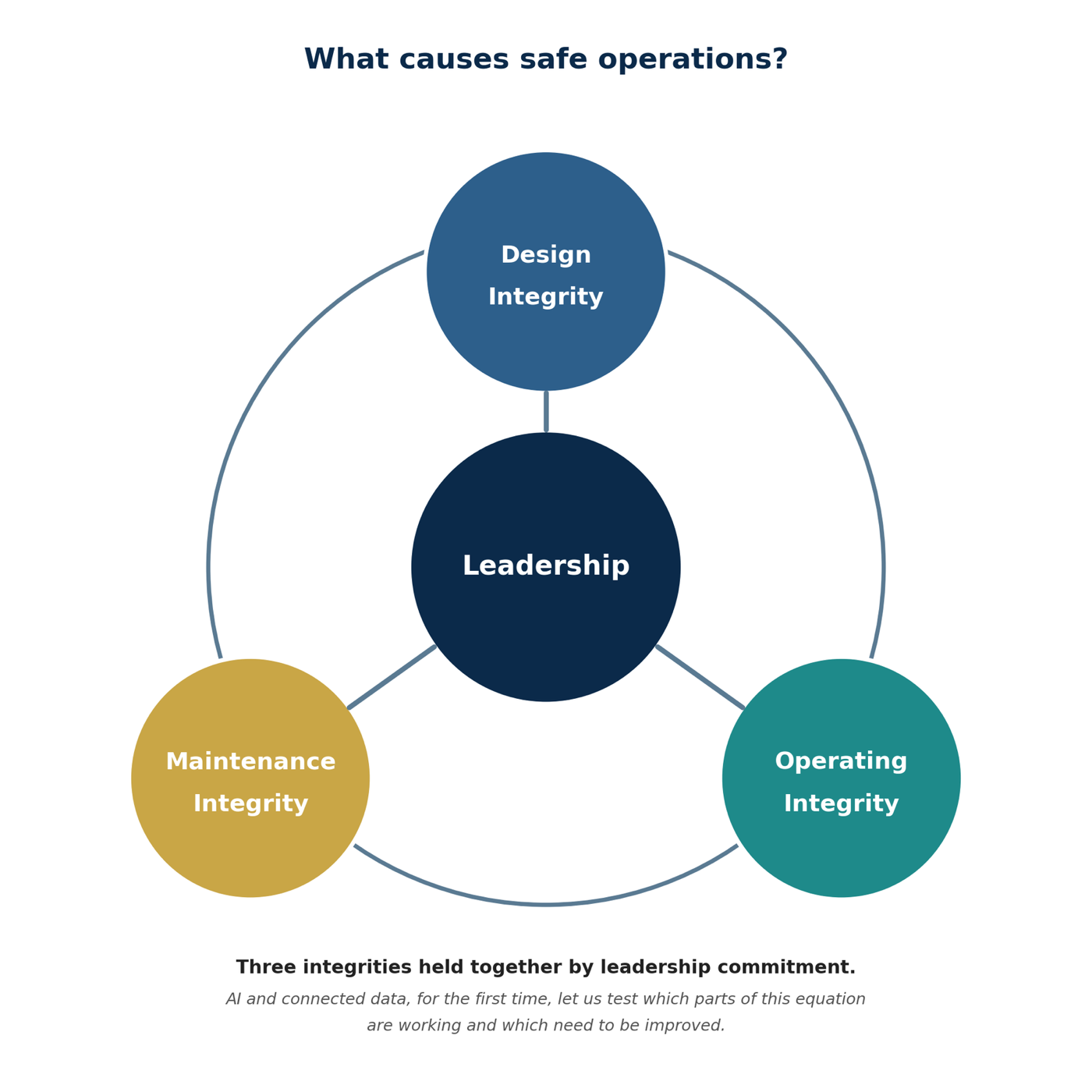
This model highlights that safe operations are not the result of a single program or initiative, but the outcome of three interconnected forms of integrity — Design Integrity, Operating Integrity, and Maintenance Integrity — held together by Leadership. Each element directly influences risk, reliability, and ultimately the likelihood of an injury or major incident. The most powerful safety decisions are often made long before an employee starts a task. Design Integrity establishes the foundation for the entire lifecycle of an asset. A poor design decision can introduce latent hazards that remain hidden for years and continue affecting safety performance for the next 20 to 30 years. These weaknesses may only emerge during abnormal conditions, equipment failures, modifications, or changing operating demands. Conversely, well-designed systems eliminate hazards, simplify work, reduce human error opportunities, and create inherently safer operations.
Operating Integrity focuses on keeping equipment and processes within their intended operating limits. Most serious incidents occur during deviations from normal operations: startups, shutdowns, upset conditions, temporary repairs, or other non-standard activities. Strong operating discipline minimizes these deviations by providing clear procedures, training, and oversight that enable employees to recognize and respond appropriately to changing conditions. Maintenance Integrity complements this by preserving equipment reliability and preventing degradation from creating new risks. Poor maintenance leads to more breakdowns, more corrective work, and more opportunities for employees to intervene in situations they may not fully understand. While these efforts are often well-intended, they can result in workers going beyond their training, procedures, or competence, significantly increasing exposure to injury. At the center of all three elements is Leadership. Leadership establishes priorities, allocates resources, reinforces standards, demonstrates genuine care for employees, reviews critical risk indicators, and creates accountability for performance. When leadership actively supports design, operating, and maintenance integrity, organizations build resilient systems that not only prevent incidents but sustain safe operations over the life of the asset.
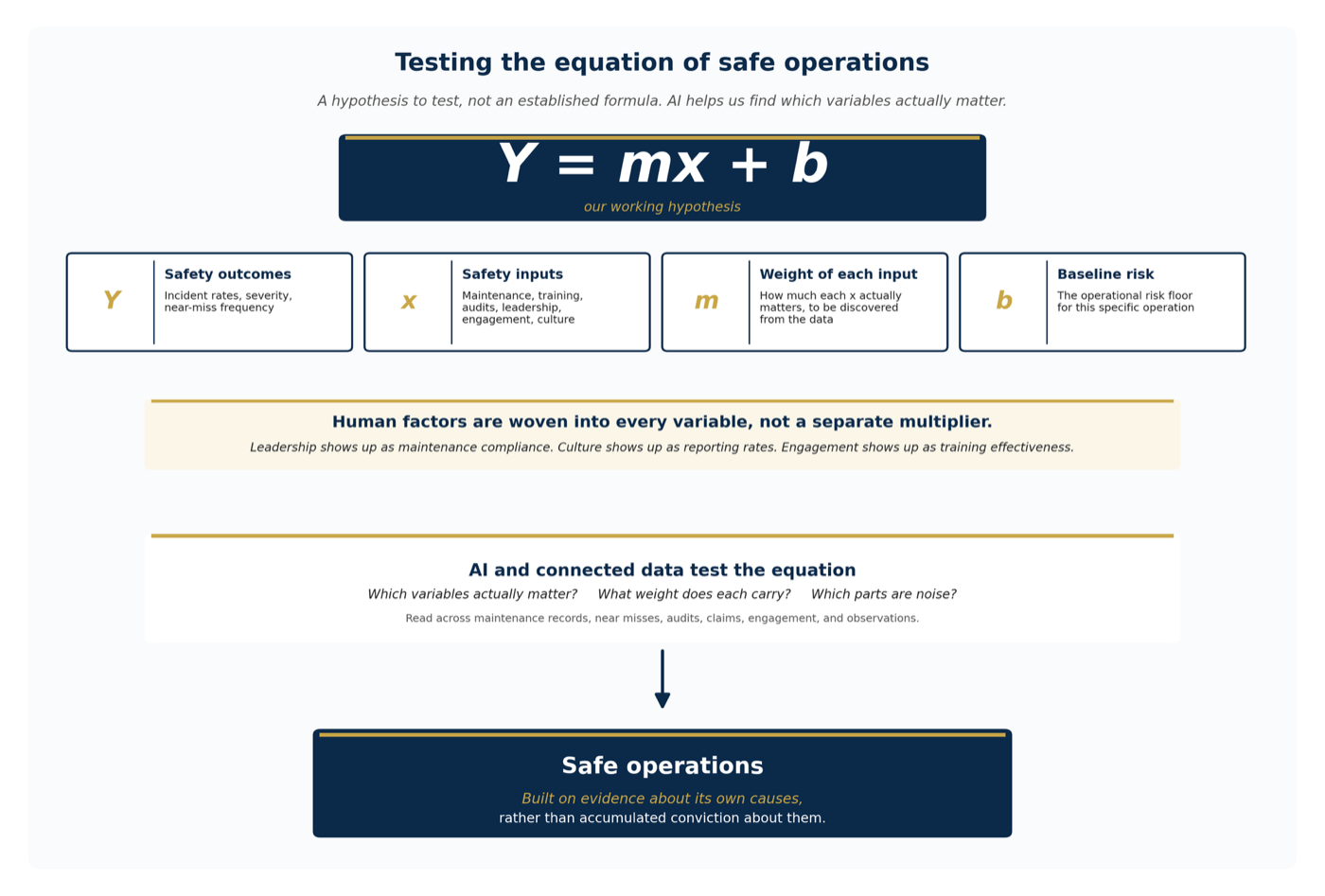
Every era of safety has carried a working theory about what produces safety: slogans and discipline, then systems and behaviors, then prevention and prediction. The theories have layered, but the field has rarely had the data infrastructure to test them. For the first time, we do. Our working hypothesis, drawn from our earlier predictive safety writing, is a straightforward linear form: Y = mx + b. Safety outcomes are a function of measurable inputs — maintenance, training, audits, leadership, engagement, culture — each carrying a weight the data is finally able to reveal, over a baseline operational risk. Human factors run through every variable rather than sitting as a separate multiplier. AI lets us hold this whole equation up to the data and ask, honestly, which parts of it are working, which parts are noise, and which parts need to be improved. And as the data gets better, AI turns safety from a lagging discipline into a predictive one. Safety, for the first time in its history, can be built on evidence about its own causes rather than on accumulated conviction about them.
If we do this well, the plateau will break. Not because the algorithms got smarter. Because the technical and the human, the objective and the subjective, the inside and the outside, are finally doing the work together. And because the people closest to the work are being trusted, and equipped, to lead it.
“The next breakthrough in safety is not going to be a better program. It is going to be a better relationship between the system, the organization’s leaders, and the people on the frontlines.”
Sources and further reading
U.S. Bureau of Labor Statistics. Census of Fatal Occupational Injuries (CFOI), 2024 release. bls.gov/iif/fatal-injuries-tables.htm
U.S. Bureau of Labor Statistics. Employer-Reported Workplace Injuries and Illnesses, 2024 release (January 2026).
U.S. Bureau of Labor Statistics. Nearly 50 years of occupational safety and health data. Beyond the Numbers.
OSHA. Commonly Used Statistics. osha.gov/data/commonstats
OSHA. Final Rule on Process Safety Management of Highly Hazardous Chemicals. 29 CFR 1910.119, 1992.
U.S. Chemical Safety and Hazard Investigation Board. Investigation reports on Phillips 66 Pasadena (1989), BP Texas City (2005), and Deepwater Horizon (2010).
Encyclopedia of U.S. Labor and Working-Class History. The Safety First Movement and Elbert H. Gary's Committee on Safety at U.S. Steel, 1906–1908.
Heinrich, H. W. Industrial Accident Prevention. McGraw-Hill, 1931.
Manuele, F. A. Reviewing Heinrich: Dislodging Two Myths from the Practice of Safety. Professional Safety, 2011.
Bird, F. E. & Germain, G. L. Practical Loss Control Leadership. Loganville, GA: Det Norske Veritas, 1985 (and earlier 1969 ratio research).
Reason, J. Managing the Risks of Organizational Accidents. Ashgate, 1997.
Leveson, N. Engineering a Safer World: Systems Thinking Applied to Safety. MIT Press, 2011.
Leveson, N. STPA Handbook. MIT, 2018.
Hollnagel, E., Wears, R. L., & Braithwaite, J. From Safety-I to Safety-II: A White Paper. The Resilient Health Care Net, 2015.
Hollnagel, E. Safety-II in Practice. Routledge, 2018.
Conklin, T. The 5 Principles of Human Performance. 2019.
Conklin, T. Pre-Accident Investigations. Ashgate, 2012.
Mansdorf, Z. and BST. Serious Injury and Fatality Prevention. Professional Safety, 2011.
Campbell Institute, National Safety Council. Serious Injury and Fatality Prevention: Perspectives and Practices. 2018.
Campbell Institute. Designing Strategy for Serious Injury and Fatality Prevention. 2020.
ISN / Campbell Institute. Serious Injury and Fatality Insights: An Analysis of 55,000+ Records. 2020.
Hallowell, M. R. and the Construction Safety Research Alliance, University of Colorado Boulder. Energy-Based Safety and the Safety Classification and Learning (SCL) framework. Multiple research publications, 2017 onward.
Edmondson, A. C. Learning from Mistakes Is Easier Said Than Done: Group and Organizational Influences on the Detection and Correction of Human Error. Journal of Applied Behavioral Science, 1996.
Edmondson, A. C. Psychological Safety and Learning Behavior in Work Teams. Administrative Science Quarterly, 1999.
Edmondson, A. C. The Fearless Organization. Wiley, 2019.
Geller, E. S. The Psychology of Safety Handbook. CRC Press, 2001.
Wilson, L. The SafeStart Methodology. SafeStart / Electrolab, 1998 onward.
Covey, S. R. The 7 Habits of Highly Effective People. Free Press, 1989. (Source for the Dependent→Independent→Interdependent maturity arc adapted into the Bradley Curve.)
DuPont Sustainable Solutions. The Bradley Curve. 1995. (Discussed critically.)
Hudson, P. and Parker, D. The Hearts and Minds toolkit and the Hudson Safety Culture Ladder. Energy Institute (publicly available).
ISO 45001:2018 Occupational Health and Safety Management Systems.
Carnegie Mellon University / Predictive Solutions. Predictive Safety Analytics research using 112M observations.
Pearlman, L. The Evolution of Safety: Complete Package. Internal working document, AFL, April 2026.
About the authors
Larry Pearlman is Vice President, Environment, Health, Safety & Security at AFL Global. He has more than thirty years of experience in safety, culture, leadership, and change management, working with teams from frontline employees to C-level executives across Fortune 100 organizations. He is also an adjunct professor at the University of Illinois, where he teaches at the master's level on employee engagement and change management.
Eduardo Lan is a business, culture, safety, and AI integration consultant based in Toronto, working across heavy industry, manufacturing, oil and gas, utilities, mining, and construction in North and Latin America in English and Spanish, with engagements at Fortune 100 and Global 500 organizations. He holds a Master of Science in Organization Development and Change from Penn State and is a Canadian Registered Safety Professional (CRSP). His work focuses on the integration of culture, leadership, operations, safety, and AI.
The ideas in this paper draw on decades of combined safety practice across heavy industry, manufacturing, mining, construction, and capital projects in the United States, Canada, Mexico, and South America.